
Google is no longer just a search engine. It is an answer engine. It reads meaning, evaluates trust, and decides whether your content genuinely helps someone or just exists to rank. That shift is the entire story of why traditional SEO no longer delivers what it once did.
This guide breaks down exactly what changed, why it matters, and what you need to do differently in 2026.
What is Traditional SEO? (Old-School SEO Explained)
Traditional SEO refers to the practices that dominated search before roughly 2015. At that time, Google’s algorithms were relatively simple. They matched keywords on a page to keywords in a search query. Whoever had the most exact matches and the most backlinks usually ranked.
The core tactics of that era included keyword stuffing (repeating a phrase as many times as possible), acquiring backlinks in bulk regardless of source quality, targeting exact match domains, and writing thin content padded out to hit a word count. It worked because the algorithm was easy to manipulate. That era is over.
What is Modern SEO? (AI-Driven SEO Explained)
Modern SEO is built around the user first and the algorithm second. Search engines today use AI-powered systems to interpret what someone actually wants when they search, not just which words they used. Google’s systems evaluate content quality, topical depth, site authority, and page experience before assigning rankings.
The focus has shifted to search intent, semantic relevance, and genuine expertise. AI-driven features like Google’s AI Overviews now generate direct answers at the top of results, which means content needs to be clear, structured, and authoritative enough to be cited, not just indexed. Modern SEO is more complex than the old approach, but it rewards businesses that genuinely invest in quality.
Modern SEO vs Traditional SEO: Key Differences
| Factor | Traditional SEO | Modern SEO |
|---|---|---|
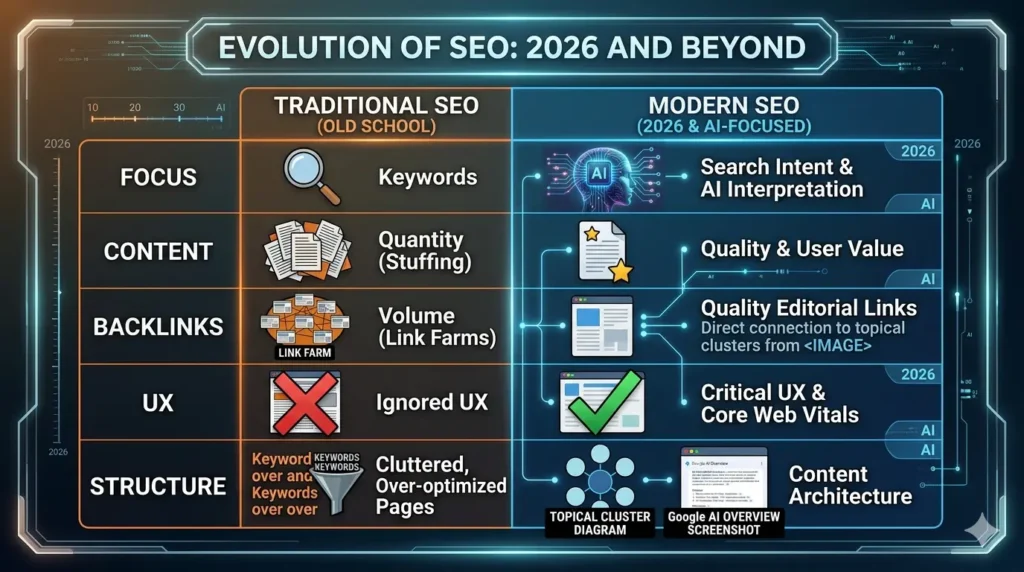
| Focus | Keywords | Search Intent |
| Content | Quantity | Quality and Value |
| Backlinks | Volume | Relevance and Authority |
| User Experience | Ignored | Critical ranking factor |
| Algorithm | Static and rule-based | AI-driven and context-aware |
| Ranking | Easier to manipulate | Harder, smarter, more sustainable |
Search Intent vs Keywords: The Biggest Shift in SEO
The single biggest change in SEO over the past decade is the move from keyword matching to intent matching. A keyword tells Google what words you used. Intent tells Google what you actually want.
There are three core types of search intent. Informational intent covers searches where someone wants to learn, such as “how does SEO work.” Navigational intent is when someone is looking for a specific site or page. Transactional intent covers searches where someone is ready to act, buy, sign up, or download.
A keyword-only strategy fails because the same phrase can carry completely different intent depending on context. Someone searching “best running shoes” may want a comparison list. Someone searching “buy running shoes online” is ready to purchase. A page optimized purely for the phrase misses both unless the content actually matches what those searchers want
Content Strategy: From Keyword Stuffing to Topic Authority
Old SEO logic was simple: one keyword, one page, repeat as often as possible. Modern SEO works on a fundamentally different model.
Today, Google rewards topical authority. That means covering a subject in depth across a cluster of related pages, all connected through internal links, rather than publishing isolated keyword-targeted pages. A pillar page covers the broad topic. Cluster pages go deep on specific subtopics and link back to the pillar.
This structure signals to Google that your site genuinely understands a subject area, not just one narrow angle of it. Depth, coverage, and logical internal linking have replaced keyword density as the core content strategy signals.
Link Building: Quantity vs Quality in Modern SEO
In traditional SEO, more links meant higher rankings. Entire industries built around manufacturing backlinks at scale, through link farms, private blog networks, and directory submissions. Google’s Penguin update in 2012 began targeting those practices, and SpamBrain has continued that work ever since.
In modern SEO, one editorial backlink from a relevant, authoritative website carries more weight than hundreds of low-quality links. Niche relevance matters as much as domain authority. Digital PR, original research, and genuinely useful content are the strategies that earn those links naturally. Toxic backlinks from spammy sources can actively damage your rankings today, not just fail to help them.
Technical SEO: Then vs Now
Traditional technical SEO was mostly about basic indexing, meta tags, and making sure your site did not have broken pages. The bar was low.
Modern technical SEO covers a much wider range. Google’s Core Web Vitals measure real user experience through three signals: LCP (how fast the main content loads), INP (how quickly the page responds to interaction), and CLS (whether the layout shifts unexpectedly while loading). These directly affect rankings.
Beyond that, mobile-first indexing means Google now evaluates your mobile site as the primary version. Structured data helps search engines understand what type of content each page contains. Crawl efficiency determines whether Google can reach and process all your important pages in time.
User Experience: A New Ranking Factor
User experience was largely irrelevant to traditional SEO. If a page ranked, it ranked, regardless of whether visitors bounced immediately or stayed to read.
Modern Google pays attention to engagement signals. Dwell time (how long someone stays on your page), click-through rate from search results, and page speed all influence how Google evaluates your content’s real-world usefulness. A page that ranks but drives immediate back-clicks sends a signal that it did not actually satisfy the searcher. Over time, that signal pulls rankings down.
Good UX is now inseparable from good SEO.
Role of AI in Modern SEO
AI has changed SEO in two ways: how search engines evaluate content, and how results are displayed to users.
On the evaluation side, Google uses AI to interpret context, entities, and meaning rather than just surface-level keyword patterns. On the display side, AI Overviews now generate synthesized answers directly on the results page, pulling from content that is authoritative, clearly structured, and factually direct.
Entity-based SEO is becoming more important. Google understands people, places, organizations, and concepts as distinct entities, not just strings of text. Building a clear content identity around the topics your site covers helps Google associate your pages with those entities. According to Search Engine Journal’s coverage of AI search trends, optimizing for AI-generated answers is now a distinct layer of SEO strategy, separate from but connected to traditional ranking work.
Common Mistakes When Transitioning to Modern SEO
The most common mistake is continuing to optimize for keywords without checking whether the content matches search intent. A well-written page targeting the wrong intent will not rank regardless of technical quality.
Using AI-generated content without editing it thoroughly is another growing problem. Google’s helpful content systems are designed to identify content written primarily to rank rather than to genuinely help. Unedited AI output often falls into that category.
Weak topical authority is also a persistent issue. Publishing a single page on a topic and expecting it to rank in a competitive space rarely works. Coverage and depth across related content is what builds genuine authority.
Future of SEO: What is Coming Next?
Zero-click searches are growing. AI Overviews, featured snippets, and knowledge panels answer questions without requiring a click. Content strategy needs to account for this by targeting commercial and transactional queries more deliberately alongside informational ones.
Voice and visual search are expanding the types of queries that reach search engines. Conversational, question-based content performs better in both formats. Personalised SERPs mean two people searching the same term may see different results based on location, history, and device.
E-E-A-T (Experience, Expertise, Authoritativeness, Trustworthiness) is becoming the dominant quality framework. Sites that demonstrate real-world expertise through author credentials, original insights, and consistent accuracy will hold a structural advantage as AI competition increases.
Conclusion: Modern SEO vs Traditional SEO, Final Verdict
Traditional SEO was about satisfying an algorithm. Modern SEO is about satisfying the person searching, and letting the algorithm catch up to that. The businesses that understand this distinction are the ones building durable organic traffic in 2026.
The formula is straightforward: match search intent, build topical authority, earn quality links, and keep your site technically healthy. For a complete breakdown of how all these elements work together, read our Modern SEO Guide, which covers the full strategy from content clusters to AI search optimization.
According to Google’s Search Quality Evaluator Guidelines, the principles of E-E-A-T sit at the core of how quality is assessed across all content types. That is the clearest signal of where SEO is headed and what will keep working long-term.
Frequently Asked Questions
What is the main difference between modern SEO and traditional SEO?
Traditional SEO focused on keyword repetition and backlink volume. Modern SEO focuses on search intent, content depth, user experience, and topical authority. The goal shifted from satisfying an algorithm to genuinely serving the person searching.
Does traditional SEO still work in 2026?
Some basics like using keywords in titles and headings still apply. But the manipulation-based tactics of traditional SEO such as keyword stuffing, bulk link building, and thin content actively harm rankings today rather than helping them.
Why is search intent important in modern SEO?
Because Google’s AI systems now evaluate what a searcher actually wants, not just what words they used. A page that does not match intent will not rank consistently, regardless of how technically optimized it is.
Is AI replacing SEO?
No. AI is changing how SEO works, not eliminating it. Strong content, technical health, and genuine authority still determine rankings. AI-powered features have added a new optimization layer but have not removed the need for solid SEO foundations.
How do I switch from traditional SEO to modern SEO?
Start by auditing your existing content for search intent alignment. Then build topical depth by creating supporting cluster pages around your core topics. Prioritize page experience and technical health. Focus link building on relevance and authority rather than volume.