
Modern SEO is not just about keywords anymore. It is about helping Google truly understand your content and trust your website. If you have ever felt confused by SEO, you are not alone. Most beginners think it is some complex technical puzzle. It is not. This guide breaks it down in plain language so you can actually start doing it.
What is Modern SEO? (Beginner-Friendly Definition)
Modern SEO stands for Search Engine Optimization. In simple words, it is the process of making your website easy for search engines like Google to find, understand, and show to the right people.
But here is what most beginners miss: modern SEO is not just about putting keywords on a page. It is about giving people the exact answer they are looking for, building trust with your audience, and making sure your website works properly behind the scenes.
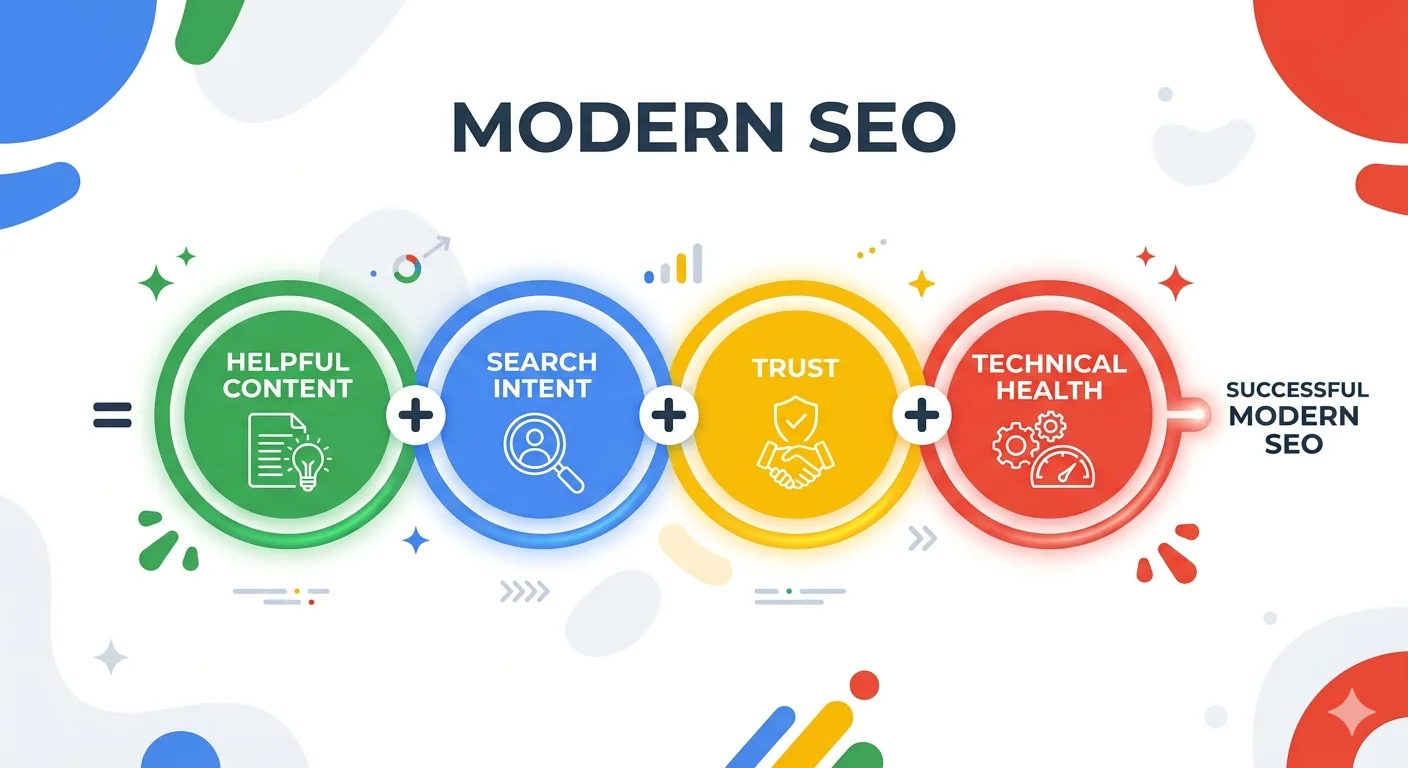
Mini Takeaway: Modern SEO = Content + Intent + Trust + Technical Health
If your website does all four of those things well, search engines will reward you with free, consistent traffic over time.
Why Modern SEO is Important for Beginners
A lot of beginners skip SEO because they think it is only for big brands with big budgets. That is not true.
Here is why SEO matters even if you are just starting out:
It brings free traffic. When your page ranks on Google, people click it without you paying for ads. That traffic compounds over time.
It builds trust with users. Pages that show up at the top of Google feel more credible. Good SEO helps you earn that position.
It supports long-term growth. Unlike paid ads that stop the moment your budget runs out, SEO keeps working for you month after month.
Here is a real example: a small personal finance blog can rank higher than a major news website if it provides a clearer, more helpful answer to a specific question. Google does not care about the size of your website. It cares about the quality and relevance of your content.
How Search Engines Work (Simple Explanation)
Before you can do SEO, you need to understand what search engines are actually doing. Think of Google like a giant library. Here is how it works in three simple steps.
Crawling
Google uses bots (called crawlers or spiders) to visit websites and read their content. This is how Google discovers new pages. If your page is not crawlable, Google will never find it.
Indexing
Once Google reads your page, it stores it in its index. Think of this like Google filing your page into the right shelf of that library. If your page is indexed, it is eligible to appear in search results.
Ranking
When someone searches for something, Google goes through its index and picks the best, most relevant pages to show. The order it shows them in is the ranking. Pages that best match what the user wants end up at the top.
That is the full cycle: crawl, index, rank. SEO is the work you do to help your pages perform well in each of these three stages.

The 3 Main Parts of Modern SEO
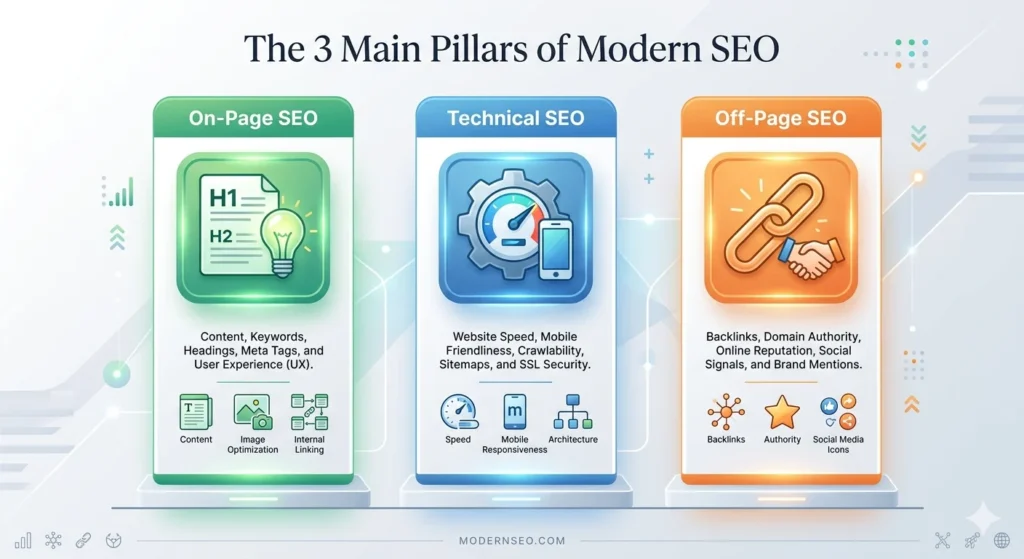
Modern SEO sits on three pillars. You need all three working together to see real results.
1. On-Page SEO
This is everything you do directly on your page. It includes writing helpful content, using your target keyword naturally in headings and paragraphs, structuring your page with clear H2 and H3 headings, and making your content easy to read.
A simple example: if you are writing about “how to bake sourdough bread,” your page should actually teach someone how to bake it well, not just mention the phrase a dozen times and move on.
2. Technical SEO
This covers the behind-the-scenes health of your website. Things like how fast your pages load, whether your site works properly on mobile phones, whether there are broken links or pages Google cannot access.
You do not need to be a developer to handle basic technical SEO. Tools like Google Search Console show you exactly what needs fixing, and most issues have simple solutions.
3. Off-Page SEO
This is everything that happens outside your website that affects your rankings. The most important factor here is backlinks, which are links from other websites pointing to yours.
When a respected website links to your page, Google sees it as a vote of confidence. The more quality backlinks you earn, the more authority your site builds over time.
What is Search Intent in Simple Words
Search intent is the reason behind a search. It is what the person actually wants when they type something into Google.
Modern SEO lives and dies on this concept. You can write a technically perfect page, but if it does not match what the searcher actually wants, it will not rank.
There are three main types:
Informational: The person wants to learn something. Example: “how does SEO work” or “what is a backlink.”
Navigational: The person is looking for a specific website or page. Example: “Google Search Console login.”
Transactional: The person is ready to do something, buy, sign up, or download. Example: “best SEO tool free trial.”
Here is a practical way to think about it: if someone searches “best budget phone,” they want a list of options with honest comparisons. They do not want a definition of what a budget phone is. Match your content to the intent, and you are already ahead of most beginners.
Simple Example of Modern SEO in Action
Let us say you want to rank for the keyword “best budget phone under 300.”
A beginner approach would be to write a generic article stuffed with that phrase. A modern SEO approach looks like this:
Good content structure: Start with a clear answer or recommendation at the top. Then go deeper with comparisons, specs, and use cases.
Helpful answers: Cover the questions your reader actually has, like battery life, camera quality, and durability, not just price.
Clear headings: Use H2 headings for each phone model or category so the page is easy to scan and so Google can read its structure clearly.
Matching intent: Since the search is transactional, the page should help someone make a decision, not just inform them.
That is modern SEO in practice. It is strategic writing, not keyword tricks.
Simple Step-by-Step Guide to Start Modern SEO
Here is a beginner-friendly process you can follow right now.
Step 1: Choose a Topic
Pick something specific. “SEO tips” is too broad. “SEO tips for new bloggers” is much better. Narrow topics face less competition and attract more targeted readers.
Step 2: Understand Search Intent
Before you write a single word, search your target keyword on Google. Look at the top results. Are they listicles, how-to guides, or product comparisons? That tells you exactly what format and angle your content should take.
Step 3: Write Helpful Content
Write to answer the question fully. Cover what the reader needs to know, address common follow-up questions, and make it easy to read. Short paragraphs, simple sentences, and clear language beat long academic blocks every time.
Step 4: Optimize Title and Headings
Put your primary keyword in your page title and in at least one H2 heading. Keep it natural. If it sounds forced, rewrite it. Google rewards natural, readable writing.
Step 5: Improve Website Speed
A slow page loses visitors and ranks poorly. Use Google’s free PageSpeed Insights tool to check your site speed and follow the recommendations it gives you. This is one of the quickest wins in technical SEO.
For a deeper look at how all of these pieces connect inside a full SEO strategy, read our Modern SEO Guide which covers everything from topical authority to AI search in one place.
How Long Does Modern SEO Take to Work?
This is the question every beginner asks, and the honest answer is: it takes time.
1 to 3 months: Google starts crawling and indexing your content. You may see early impressions in Search Console but not many clicks yet.
3 to 6 months: If your content is solid and consistent, you will start to see real traffic growth. Rankings begin to stabilize.
6 months and beyond: This is where SEO starts compounding. Pages you published months ago keep attracting traffic. Your authority builds. Results become more predictable.
The businesses that win at SEO are the ones that keep going through the early months when results are not obvious yet. According to Google’s own SEO documentation, patience and consistent quality are the two most important factors for new sites.
Final Thoughts: Start Simple, Grow Smart
SEO feels complicated from the outside. Once you understand the basics, it becomes a system you can actually follow.
Focus on one thing: help the person searching find the best possible answer to their question. Do that consistently, keep your website technically healthy, and build your content one topic at a time. That is what modern SEO is.
You do not need expensive tools or years of experience to start. You need clarity on what your audience is searching for and the consistency to keep showing up for them. As Moz’s Beginner’s Guide to SEO puts it, SEO is a long-term channel, but it is one of the most reliable ways to grow an online presence without relying on paid traffic.
Start small. Stay consistent. The results will follow.
Frequently Asked Questions (FAQ)
What is modern SEO in simple words?
Modern SEO is the practice of helping search engines understand your website and showing your content to people who are actively searching for it. It focuses on content quality, search intent, technical health, and trust signals rather than keyword tricks.
Is SEO hard for beginners?
Not if you approach it step by step. The basics of SEO, writing helpful content, optimizing headings, and making your site fast, are things any beginner can learn and apply without technical expertise.
Can I do SEO without technical skills?
Yes. On-page SEO and content strategy require no technical background. Basic technical SEO can be handled with free tools like Google Search Console and PageSpeed Insights, which guide you through fixes without needing to write code.
How do I learn SEO step by step?
Start with search intent and keyword research. Then learn on-page SEO basics. Then address technical health. Build your knowledge one layer at a time rather than trying to learn everything at once.
Does SEO still work in 2026?
Absolutely. SEO has evolved, but it has not lost its value. Strong content, technical health, and genuine authority still determine who ranks. AI-powered search features have changed how some results are displayed, but the fundamentals of good SEO remain the same.