
If AI answers everything, do websites still matter?
It is a fair question. AI Overviews appear before any organic result. Chatbots give instant answers without linking to a single page. Click-through rates are dropping on certain query types. It looks, on the surface, like SEO is losing its grip.
But that surface reading is wrong. SEO still works in 2026. What has changed is what SEO means and how you do it well.
Why Everyone is Asking “Does SEO Still Work in 2026?”
The anxiety is understandable. Marketers and business owners who relied on informational content to drive traffic are seeing numbers shift. AI-generated answers are absorbing clicks that used to go to organic results. Zero-click searches are increasing across certain query categories.
Add to that the constant wave of headlines declaring SEO dead, and it is easy to see why people are nervous. But most of those traffic drops are not SEO failing. They are the result of one specific content type, generic informational articles, losing ground to AI-generated summaries. That is not the death of SEO. It is a signal to evolve the strategy.
How AI Search Works Today (And Why It Changes SEO)
Traditional search gave you ten blue links. You clicked one, visited the site, and got your answer. That model is not gone, but it now shares the page with AI-generated summaries that synthesize answers directly at the top.
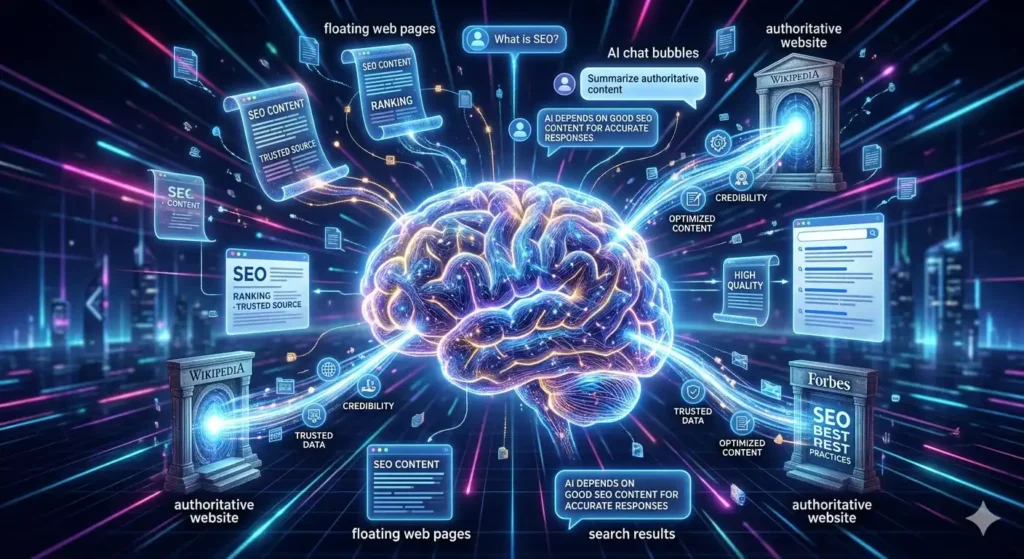
The important thing to understand is how those AI answers are built. They do not generate information from thin air. They pull from indexed web content, selecting sources that are authoritative, clearly structured, and factually accurate. The process has shifted from “which page ranks highest” to “which source gets cited.”
That distinction matters for your strategy. Visibility in 2026 does not always mean the top organic position. It can also mean being the source an AI answer draws from. Both outcomes require strong SEO fundamentals. The entry point has changed; the foundation has not.
Does SEO Still Work in 2026? (Clear, Data-Driven Answer)
Yes. SEO still works in 2026, but it now operates across more surfaces than before.
Good SEO now influences where you appear in traditional organic results, whether your content gets cited in AI-generated answers, and how your brand shows up across the broader search experience including knowledge panels, featured snippets, and local results.
Search remains one of the highest-intent marketing channels available. Someone actively searching for a product, service, or answer is already in buying or learning mode. No other channel delivers that consistently at scale without paid spend. Businesses that write SEO off based on changing click patterns are leaving long-term organic growth on the table.
What Has Changed in SEO Because of AI
The mechanics have shifted in four important ways.
Keywords alone no longer determine relevance. Search engines now evaluate intent, so the same keyword can require completely different content depending on what the searcher actually wants to accomplish.
Individual pages matter less than topic coverage. Google now associates sites with entities and subject areas, not just isolated keyword-optimized pages. Depth and consistency across a topic build the kind of authority that sustains rankings.
Backlink volume has been replaced by trust and relevance as the primary off-page signal. A handful of editorial links from respected sources in your niche outperforms hundreds of low-quality links from unrelated sites.
Traffic volume is no longer the only metric worth tracking. Being cited in an AI answer, earning a featured snippet, or appearing in a local knowledge panel all represent real visibility even when they do not generate a direct click.
What Still Works in SEO in 2026 (Core Ranking Factors)
Despite everything that has changed, several fundamentals remain just as important as they have ever been.
Helpful, human-first content consistently outperforms content written primarily to rank. If a page genuinely answers a question better than anything else available, it tends to hold its position over time.
Strong topical authority built through content clusters and pillar pages signals to Google that your site is a reliable source on a subject, not just a one-off publisher.
Internal linking helps search engines understand your site structure and distributes authority to the pages that need it most. It also keeps users exploring your content longer.
Technical SEO, specifically crawlability, page speed, mobile performance, and clean indexing, remains the foundation everything else sits on. Strong content on a technically broken site does not rank.
Brand signals and trust factors, including consistent NAP information for local businesses, author credibility, and genuine user engagement, are playing an increasingly important role in how Google evaluates site quality.
What No Longer Works in SEO
Keyword stuffing is not just ineffective now. It actively triggers over-optimization signals and suppresses rankings.
Thin AI-generated content published without meaningful editing or original perspective is one of the fastest ways to lose ground after a core update. Google’s helpful content systems are built specifically to identify and demote this type of content.
Spammy backlinks from irrelevant or low-quality sources can now hurt rankings rather than helping them. Google’s SpamBrain system identifies unnatural link patterns and penalizes them.
Writing for bots instead of users, optimizing for crawlers at the expense of readability and usefulness, is the oldest trap in SEO. It has never produced durable results and it certainly does not in 2026.
SEO vs AI Search: Are They Competing or Working Together?
SEO and AI search are not in opposition. They are interdependent.
AI search systems need websites as their primary data source. They cannot generate authoritative answers without drawing from indexed content produced by publishers, businesses, and subject matter experts. Without SEO-driven content, AI answers would have nothing reliable to cite.
The practical implication is that good SEO now serves two audiences: the human reader and the AI system selecting sources for its answers. Content that is clear, structured, authoritative, and factually grounded performs well for both. The optimization targets have expanded, not disappeared.
How to Optimize for AI Search (New SEO Playbook)
Optimizing for AI-generated answers requires a shift in how content is structured, not just what it covers.
Start with clear, direct answers near the top of each section. AI systems consistently pull from content that answers the question first and elaborates afterward, not from content that buries the answer in paragraphs of context.
Use semantic SEO by covering the entities, concepts, and related questions that surround your main topic. This signals topical depth and helps AI systems connect your content to the subject it addresses.
Build topical authority through a cluster strategy. A pillar page supported by cluster pages covering specific subtopics gives search engines and AI systems a clear map of your expertise across a subject area.
Add FAQ sections with concise, direct answers. These are among the most consistently cited content formats in both featured snippets and AI answers.
Improve your E-E-A-T signals through author credentials, original research, accurate sourcing, and transparent information about who is behind the content. According to Semrush’s 2025 State of Search report, E-E-A-T signals are now among the most influential factors in content quality assessment.
Real Example: How a Page Ranks vs Gets Featured in AI Results
Consider a page targeting the query “how long does SEO take to work.”
A page that ranks organically for that term might have 2,000 words covering timelines, case studies, and variables. That depth earns the ranking.
A page that gets cited in an AI answer likely opens with something like: “Most SEO strategies show early results in 3 to 6 months, with significant growth appearing around 12 months for competitive keywords.” That direct, structured opening is what AI systems pull. Clarity wins the citation. Depth wins the ranking. Ideally, your page does both.
Future of SEO Beyond 2026
Zero-click searches will continue growing, particularly for informational queries. The strategic response is to prioritise commercial, transactional, and comparison content that still drives clicks alongside informational coverage.
Personalised AI responses based on user history and location will make brand familiarity increasingly important. Users who already know your brand are more likely to click your result even in a crowded AI-assisted results page.
Voice and visual search are expanding the formats that drive queries. Conversational, question-based content and properly tagged images are becoming more relevant to overall search visibility.
SEO is evolving toward what some practitioners are calling “search experience optimisation”: a broader discipline covering every surface where content can appear and influence a searcher, not just the traditional organic results list.
Should You Still Invest in SEO in 2026?
Yes. Especially if you are thinking about growth over a 12 to 24 month horizon.
SEO builds sustainable traffic that does not stop when a budget runs out. It builds brand authority that compounds as your content library grows. And it creates a competitive advantage that is genuinely difficult for competitors to replicate quickly.
Businesses that pull back from SEO because of short-term AI disruption are making a long-term mistake. The landscape is shifting, but the opportunity is still significant for anyone willing to adapt their approach rather than abandon it.
Conclusion: Does SEO Still Work in 2026? Final Verdict
SEO is not dead. It is more demanding than it used to be, which means the gap between businesses that do it well and those that do not is wider than ever.
Success in 2026 requires matching search intent, building genuine topical authority, and structuring content in ways that work for both human readers and AI systems. Adaptation is the real ranking factor now.
For a complete breakdown of how modern SEO works across all these dimensions, read our Modern SEO Guide, which covers everything from content clusters to technical health to AI search optimization in one place.
Frequently Asked Questions
Does SEO still work in 2026?
Yes. SEO drives organic rankings, AI answer citations, and brand visibility across the full search experience. The strategy has evolved, but the channel remains one of the most effective for long-term traffic and authority growth.
Is AI replacing SEO?
No. AI search systems depend on indexed web content to generate their answers. Strong SEO is what makes your content eligible to be cited in those answers. The two are connected, not competing.
What is the biggest change in SEO in 2026?
The shift from keyword-based ranking to AI-driven content selection. Search engines now evaluate intent, authority, and content structure, not just keyword presence. Being cited in an AI answer is now as valuable as ranking on page one.
How do I optimize for AI search?
Structure your content with direct answers at the top of each section, cover topics with semantic depth, build topical authority through content clusters, and include FAQ sections with concise responses. These formats are consistently selected by AI systems. According to Google’s documentation on helpful content, content written primarily for people, not search engines, is what performs best in both traditional and AI-assisted search.
Is SEO still worth learning in 2026?
Yes, more than ever. As AI increases competition for visibility, the businesses with strong SEO foundations will hold a structural advantage. The skill set is evolving, but demand for it is growing alongside that evolution.