

Your website is live. Your product or service is solid. But when your ideal customers type their most relevant queries into Google, your business is nowhere to be found. A competitor sometimes a weaker one dominates the top of the search engine results pages (SERPs) and captures every click, every lead, every sale.
This is the exact problem SEO consulting was built to solve.
But here’s what most agencies will never admit: the SEO consulting industry is full of generalists, underqualified freelancers, and templated agencies that will collect your retainer for six months before you realize nothing has actually moved. Choosing the wrong SEO consultant doesn’t just waste money, it can genuinely damage your website’s visibility in search engine results through toxic backlinks, keyword cannibalization, or technical errors that take years to reverse.
This guide gives you everything you need. You’ll learn what SEO consulting really is, what an SEO consultant actually does day to day, how much it costs, what to ask before you sign anything, the red flags that expose bad actors, and exactly how to find and choose the right consultant or SEO company for your specific business needs.
Let’s get into it.
What Is SEO Consulting?
SEO consulting is a professional service in which a trained search engine optimization expert, either a freelance SEO consultant or an SEO agency. Analyzes your website, audits your current SEO performance, and provides expert guidance and a strategic roadmap designed to improve your website’s visibility in search engine results.
Unlike hiring a full-service SEO agency that manages everything for you, a search engine optimization consultant often acts as a strategic advisor: diagnosing problems, building the roadmap, and either implementing changes directly or coaching your internal team through execution.
The end goal of every SEO consulting engagement is fundamentally the same — to get more of the right people to find your business through organic search, without paying for every single click the way you would with paid advertising.
According to BrightEdge, organic search drives 53% of all measurable website traffic across industries, making it the single highest-volume channel for most businesses. Despite this, the vast majority of websites remain dramatically underoptimized, leaving enormous amounts of organic traffic and the revenue that comes with it, completely untouched.
A good SEO consultant helps businesses unlock exactly that opportunity.
Authority Data Point: A study by Terakeet found that acquiring new customers through a well-executed SEO strategy costs 87% less than through paid search advertising. That’s not a minor efficiency gain, it’s a structural competitive advantage.
SEO isn’t a one-time fix or a technical checkbox. It’s an ongoing discipline that combines deep understanding of search engine algorithms, user psychology, content strategy, and data analytics. When you work with a genuinely expert SEO consultant, you’re bringing in someone who lives and breathes these intersections every single day.
What Does an SEO Consultant Actually Do?
This is where most SEO consulting articles get frustratingly vague. Let’s be specific, because when you’re evaluating someone to handle your online presence and business growth, vague doesn’t cut it.
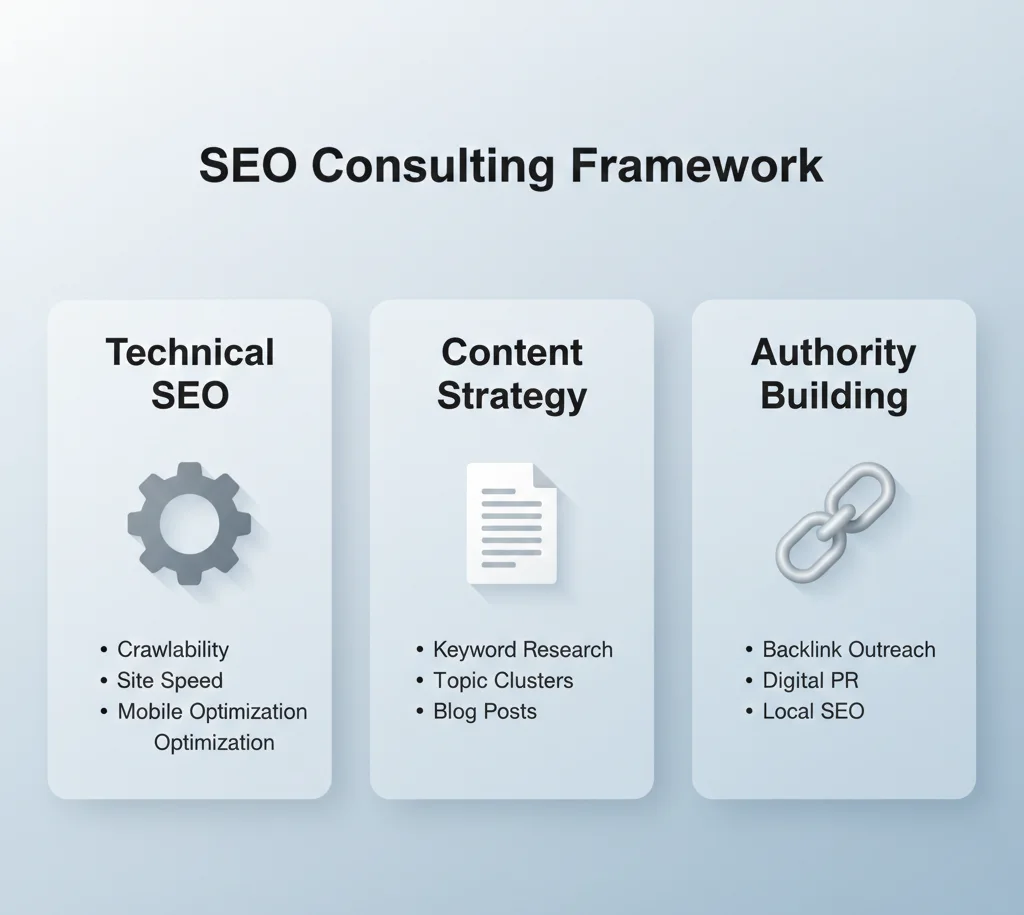
An experienced consultant’s work falls into five core disciplines. The best SEO professionals are competent across all five.
1. Technical SEO Audit and Site Performance Optimization
Before any content strategy or link building campaign can produce results, your site’s technical foundation must be solid. A comprehensive SEO audit is always the starting point. A skilled consultant uses this audit to uncover every structural issue that prevents search engines from properly crawling, indexing, and ranking your pages.
Technical SEO work includes:
Crawl efficiency and budget management — Search engine bots have a finite crawl budget. If that budget gets consumed by low-value, duplicate, or orphaned pages, your most important content may never get crawled and indexed at the frequency it deserves.
Core Web Vitals and site speed — Since Google made page experience a direct ranking signal, Core Web Vitals (Largest Contentful Paint, Cumulative Layout Shift, and Interaction to Next Paint) have become non-negotiable. A slow, unstable site loses both rankings and conversions simultaneously.
Indexability and crawlability analysis — Are your most valuable pages actually indexed by Google? Are thin or low-quality pages consuming index coverage they shouldn’t? Are important pages accidentally blocked in your robots.txt file?
Structured data and schema markup — Properly implemented schema markup helps search engines understand what your content means, not just what it says. This can earn featured snippets, FAQ results, review stars, and other rich results that dramatically improve click-through rates even without a ranking change.
HTTPS, redirect architecture, and canonical tags — Messy redirect chains, mixed content warnings, and improper canonical tags silently leak ranking authority from your most important pages.
If your website runs on WordPress, technical configuration starts at the meta level. Learn how to properly add meta tags in WordPress to ensure that your consultant’s technical recommendations are implemented correctly from the ground up.
2. Keyword Research and Search Intent Mapping
Modern keyword research isn’t simply identifying terms with high search volume. An effective SEO consultant maps every keyword to the underlying intent behind it, understanding whether someone wants to learn something, compare options, or buy right now and then builds a content architecture that satisfies that intent at every stage of the buyer journey.
This involves:
- Primary keyword identification for core commercial pages
- Secondary and semantic keyword discovery for topical depth
- Long-tail keyword research for high-conversion, lower-competition opportunities
- Competitor keyword gap analysis to find what they rank for that you don’t
- Keyword-to-page mapping to ensure each page targets a distinct topic without cannibalizing other pages’ rankings
The consultant should also be able to tell you which keywords are worth targeting based on your domain authority and competitive reality, not just volume. A site with low authority competing for keywords owned by Wikipedia and Forbes is a losing strategy from day one.
3. On-Page SEO Optimization
On-page SEO covers every element within a page that influences how search engines interpret and rank it. A strong SEO consultant helps you optimize:
- Title tags — The single most important on-page ranking signal, and the first thing users see in search results. They must balance keyword placement with compelling copy that earns the click.
- Meta descriptions — Not a direct ranking factor, but a critical click-through rate driver. A well-written meta description is the difference between a 3% and a 7% CTR on the same ranking position.
- Header structure — The H1/H2/H3 hierarchy signals content organization to search engines and improves readability for users.
- Content depth and topical coverage — Search engines reward pages that comprehensively address a topic, not pages that superficially mention a keyword.
- Internal linking architecture — Strategic internal links distribute ranking authority throughout your site and help search engines discover and prioritize your most important pages.
- Image optimization — Descriptive alt text, proper file naming, and compressed file sizes all contribute to both SEO and accessibility.
4. Content Strategy Development
Sustainable SEO isn’t just about optimizing what already exists, it requires a forward-looking content strategy that systematically builds your site’s topical authority over time. Your consultant should develop:
- A content calendar targeting high-value keywords aligned with your business goals
- A topical cluster model with pillar pages and supporting cluster content
- Content briefs that guide writers to produce search-intent-aligned, E-E-A-T-rich content
- A content refresh strategy to maintain and improve rankings for existing pages
- An editorial process that ensures every piece of content demonstrates genuine expertise, not just keyword saturation
According to HubSpot’s State of Marketing Report, companies that maintain an active blog and content strategy generate 434% more indexed pages than those that don’t. More indexed pages means more ranking opportunities, more organic traffic entry points, and more chances to build trust with both users and search engines.
5. Off-Page SEO and Backlink Acquisition
Backlinks — links from other websites pointing to yours — remain one of the most powerful ranking signals in Google’s algorithm, according to Google’s own documentation on how search works. A site with authoritative, relevant backlinks signals to search engines that real experts and publishers trust its content.
A legitimate SEO consultant builds backlinks through:
- Digital PR — Creating original research, data studies, or expert commentary that journalists and bloggers genuinely want to cite
- Guest publishing — Contributing expert articles to recognized publications in your industry
- Broken link building — Finding broken links on authoritative sites and proposing your content as a replacement
- Resource page outreach — Getting your tools, guides, or data included on curated resource pages
- Competitor backlink analysis — Reverse-engineering what’s earning links for your competitors and pursuing the same sources
No legitimate SEO consultant will promise a specific number of links per month through paid link schemes, private blog networks (PBNs), or link farms. These tactics can produce short-term ranking gains followed by manual penalties that can suppress your site for years.
Types of SEO Consulting Services
Understanding the different models of SEO consulting helps you match the right type of engagement to your specific situation and budget.
Freelance SEO Consultant
An individual expert working independently, typically on a project or monthly retainer basis. Best suited for small businesses, startups, or companies that need focused strategic expertise without the overhead of an agency. The key is vetting carefully, the freelance market ranges from world-class specialists to amateurs with an SEO certification and a Fiverr profile.
If you’re running a small business and want to understand exactly what to look for, you can hiring an SEO expert for small businesses.
SEO Agency
A team-based model with dedicated strategists, technical SEOs, content writers, link builders, and account managers. Best for mid-size to enterprise businesses with complex sites, multiple geographic markets, or highly competitive industries. Higher cost, but significantly more execution bandwidth.
Boutique SEO Consultancy
A small firm of 3–15 specialists that operates with agency depth but boutique attention. Often the best value for growing businesses, enough resources to execute comprehensively, but small enough that your account isn’t managed by a rotating cast of junior employees.
Project-Based vs. Retainer Consulting
Project-based consulting is a defined, time-limited engagement for example, a full technical SEO audit, a site migration strategy, or a complete keyword research and content map. Ideal if you have an in-house team capable of handling ongoing implementation but need expert strategic input.
Retainer consulting is ongoing monthly support covering strategy, implementation, reporting, and continuous adaptation as your site and market evolve. Best for businesses that want sustained, compounding SEO growth and don’t have the internal capability to drive it themselves.
How AI Has Transformed SEO Consulting in 2026
This is the section every other SEO consulting article ignores and it’s arguably the most important context for anyone considering hiring a consultant right now.
The emergence of Google’s AI Overviews, generative AI tools like ChatGPT and Perplexity, and Google’s continued evolution of its core ranking systems have fundamentally changed what effective SEO consulting looks like.
AI Overviews and Answer Engine Optimization (AEO)
Google’s AI Overviews now appear at the top of search results for a significant and growing percentage of queries, synthesizing answers from multiple sources before the user ever clicks a result. This means your content needs to be structured not just to rank, but to be cited within these AI-generated summaries, a discipline called Answer Engine Optimization (AEO).
An SEO consultant operating on pre-2023 assumptions won’t understand how to build for this environment. A genuinely current expert will structure your content to win both traditional ranking positions and AI citation opportunities simultaneously.
Generative Engine Optimization (GEO)
Beyond Google, a growing segment of searchers particularly higher-income, research-oriented users are turning to AI tools like ChatGPT, Perplexity, and Claude as primary research engines. Being mentioned, cited, or recommended within these generative AI environments requires different signals than traditional SEO: authoritative sourcing, original data, clear entity associations, and structured factual content that AI systems can reliably extract.
AI Content at Scale — The Double-Edged Sword
AI writing tools can produce SEO content at extraordinary speed and relatively low cost. But they also produce generic, undifferentiated content that increasingly struggles to rank against well-researched, expert-authored pieces, because Google’s Helpful Content system is specifically designed to identify and demote content that exists primarily to satisfy search engines rather than actual humans.
The consultants worth hiring in 2025 use AI as a research, efficiency, and ideation tool while ensuring every piece of content demonstrates real expertise, original insight, and genuine helpfulness. That combination is what earns sustainable rankings in the current environment.
When You Should Hire an SEO Consultant
From 10 years of observing what works and what doesn’t, here are the scenarios where bringing in an SEO consultant delivers unambiguous value:
Your site isn’t ranking for keywords it should own. If competitors consistently outrank you for searches that are directly relevant to your core business, there’s a structural problem technical, content, or authority-based that an experienced consultant can diagnose and fix with a clear action plan.
You’re launching a new website or undergoing a redesign. Website migrations are one of the most common causes of catastrophic organic traffic loss. Businesses regularly lose 30–70% of their organic traffic through a poorly managed redesign. An SEO consultant brought in before launch can ensure the new site preserves and builds on all existing SEO equity.
Your organic traffic has suddenly dropped. A sharp decline almost always signals either a Google algorithm update impact, a significant technical issue, a manual penalty, or competitor advancement. Each requires a different response, and diagnosing it incorrectly or guessing makes the situation measurably worse.
You’re entering a new market or scaling geographically. New audiences, new competitive landscapes, and new search behavior patterns require fresh strategy built around that specific context, not recycled tactics from your existing market.
Your organic traffic doesn’t convert. High traffic, low conversion rates is often a search intent mismatch, you’re ranking for informational queries but your conversion architecture is built for transactional visitors. A consultant identifies this gap and realigns your keyword strategy toward commercial intent.
You don’t have internal SEO expertise. SEO is a genuine specialist discipline that spans technical web development, content strategy, data analytics, and digital PR. Expecting your content writer, web developer, or in-house marketer to handle it competently without dedicated training is a gamble with your most valuable digital asset.
When You Do NOT Need an SEO Consultant
Equally important and rarely discussed is being honest about when consulting isn’t the right investment:
You have no defined business goals. An SEO consultant builds strategy around business objectives. If you can’t clearly articulate what you want organic search to do for your business, a consultant can’t build an aligned strategy. Get clarity on your goals first.
You’re not ready to implement recommendations. A consultant’s value is entirely realized through implementation. If internal bureaucracy, resource constraints, or developer backlog means recommendations will sit unapplied for months, you’re not ready to get value from SEO consulting.
You need immediate revenue. Paid advertising produces results in days. SEO produces compounding results over months. If cash flow demands immediate ROI, invest in paid search first, then layer in SEO as you stabilize.
Your site has fewer than 10 pages and minimal keyword opportunity. Very small, simple sites in low-competition niches may not require professional consulting. Good tools and solid self-education may be sufficient.
How Much Does SEO Consulting Cost?
Pricing varies significantly based on consultant experience, competitive market, project scope, and engagement model. Here is a realistic, transparent breakdown:
| Engagement Model | Typical Price Range | Best For |
|---|---|---|
| One-time technical SEO audit | $500 – $5,000 | Diagnosing site-wide problems |
| Project-based consulting | $1,500 – $15,000 | Migrations, strategy, audits |
| Monthly retainer (freelance) | $1,000 – $5,000/month | Focused strategy + implementation |
| Monthly retainer (boutique) | $3,000 – $10,000/month | Full-service ongoing SEO |
| Monthly retainer (enterprise agency) | $10,000 – $50,000+/month | Large sites, competitive verticals |
| Hourly consulting | $100 – $500/hour | Specific reviews or ad hoc advice |
The most important thing to understand about SEO consulting pricing is this: the cheapest option is almost never the best investment. A $299/month SEO package from a bulk agency means your account is being managed by a junior associate following a content template, not a senior strategist who understands your industry, your competitive landscape, and your specific business needs.
If budget is a genuine constraint as it is for most small businesses; there are affordable SEO services for small businesses that deliver real, measurable value. But you need to know what quality looks like before you can evaluate whether a lower-cost option actually meets that bar.
A practical way to frame SEO consulting ROI: if a well-executed strategy brings in 15 additional qualified leads per month and your average customer lifetime value is $3,000, even a $5,000/month retainer generates a 9x return within the first year. The math works when the consultant actually knows what they’re doing.
What to Ask SEO Consultants Before You Hire
This is the most overlooked part of the hiring process, and the most important. These questions are designed to reveal whether you’re talking to a genuine expert or a skilled salesperson. Listen carefully not just to what they answer, but how specificity and honesty are the tells.

“Can you show me specific results you’ve driven for clients in a similar industry?”
What a good answer looks like: They share Google Analytics or Google Search Console data (with appropriate client permission) showing clear before-and-after organic traffic growth, along with context about the competitive environment and the timeline it took.
What a bad answer looks like: Vague claims about “getting clients to page one” with no verifiable specifics, or generic case studies that show percentage increases without baseline numbers to give them meaning.
“Walk me through your technical SEO audit process. What tools do you use and what are you looking for?”
What a good answer looks like: A detailed methodology crawling the site with tools like Screaming Frog or Sitebulb, analyzing Core Web Vitals through Google Search Console, checking canonicalization, reviewing redirect architecture, auditing internal link equity, assessing indexability. They should be able to describe what they’re looking for and why it matters to rankings.
What a bad answer looks like: “We run your site through our proprietary scoring tool.” An automated score is a starting point, not an audit. It tells you nothing about what’s causing your specific ranking problems or how to fix them.
“How do you approach keyword research, and how do you decide which keywords to prioritize?”
What a good answer looks like: A search intent-first explanation, understanding buyer journey stages, balancing search volume against keyword difficulty and domain authority, mapping keywords to the right page types, and thinking about commercial value, not just traffic volume.
What a bad answer looks like: “We target the highest-volume keywords in your industry.” Volume without intent alignment is a vanity metric. An SEO consultant prioritizing traffic volume over conversion intent is optimizing for the wrong outcome.
“How do you build backlinks, and can you show me examples of placements you’ve earned for clients?”
What a good answer looks like: White-hat link acquisition methods, digital PR campaigns, expert outreach, guest contributions to genuine publications, original data and research that earns editorial links naturally. They should be able to name real publications and show you actual links they’ve earned.
What a bad answer looks like: Any mention of “guaranteed links,” link packages, private blog networks, or mass outreach to irrelevant directories. These tactics produce short-term movement followed by long-term penalties. Any SEO consultant who can’t clearly explain their link acquisition strategy in ethical terms should be disqualified immediately.
“How do you stay current with Google algorithm updates and industry changes?”
What a good answer looks like: They follow Google’s Search Central Blog, monitor industry publications like Search Engine Journal and Search Engine Land, actively test hypotheses on their own or client sites, and have a process for communicating algorithm impacts to clients in plain language.
What a bad answer looks like: “We have proprietary intelligence on how Google’s algorithm works.” Nobody outside Google has this. Anyone claiming special inside knowledge of Google’s ranking systems is either uninformed or deliberately misleading you.
“What does success look like at 3, 6, and 12 months?”
What a good answer looks like: An honest, staged description technical improvements and crawl efficiency gains in the first 30–60 days, indexation improvements and early ranking movement in months 2–4, meaningful organic traffic increases in months 5–9, demonstrable conversion impact by month 12. No guarantees of specific rankings, and a clear explanation of why guarantees are impossible.
What a bad answer looks like: “We guarantee page one rankings within 60 days.” This is either an outright fabrication or a sign that black-hat tactics are being used tactics that will produce short-lived results followed by devastating penalties.
“What metrics do you report on, and how do they connect to my business goals?”
What a good answer looks like: A reporting framework built around business-relevant metrics, organic traffic growth, ranking positions for commercially valuable keywords, organic conversion rate, leads and revenue attributed to organic search. They use Google Analytics 4 and Google Search Console as primary data sources and can explain clearly what each metric means in terms of business impact.
What a bad answer looks like: Monthly reports full of Domain Authority scores, keyword density percentages, and number of blog posts published metrics that look like activity but don’t connect to the outcomes that actually matter to your business.
“Are you currently working with any of my direct competitors?”
This isn’t necessarily a disqualifier, but you need to know. An honest consultant will disclose this and explain how they manage potential conflicts. A consultant who denies it when you later discover the truth has already demonstrated they can’t be trusted.
Red Flags: Signs of a Bad SEO Consultant
After two decades in this industry, these are the warning signs I’ve seen damage businesses repeatedly. Walk away from any consultant or agency that exhibits these behaviors:
Guaranteed rankings. Search engine rankings cannot be ethically guaranteed by anyone who doesn’t work at Google. Full stop. Any consultant who guarantees specific ranking positions is either lying about their capabilities or planning to use tactics that will eventually harm your site.
Vague or evasive answers about methodology. Legitimate SEO work is explainable in plain language. If a consultant can’t clearly describe what they’re going to do and why it will work, that’s either incompetence or deliberate opacity designed to prevent you from realizing they’re not delivering.
No interest in your business goals. An SEO consultant who jumps straight to deliverables and packages without deeply understanding your revenue model, your target customers, your competitive position, and what success looks like for your specific business is selling a template, not a strategy.
They don’t mention Google Search Console or Google Analytics. These are the foundational data sources for any legitimate SEO engagement. A consultant who doesn’t reference them in their process isn’t operating from actual performance data.
Extremely low pricing with unrealistic promises. Quality SEO consulting requires significant expertise, experience, and time. If a price seems impossible given the scope of work, it is either the work won’t happen, or it will happen in ways that damage your site.
They rely entirely on automated reports. Automated SEO tools produce data. Expert consultants interpret that data and translate it into prioritized, actionable recommendations. A report dump is not consulting.
How to Find a Good SEO Consultant
Knowing what you’re looking for is half the battle. Here’s where to actually find qualified candidates:
Referrals from Trusted Business Contacts
The most reliable source of good SEO consultants is word-of-mouth from business owners who’ve seen actual results. Ask your network: “Who handles your SEO, and are you happy with what you’re seeing?” A referral from someone who’s experienced measurable organic traffic growth is worth more than any directory listing.
Industry Communities and Professional Networks
Active SEO professionals participate in communities where real knowledge gets shared and reputations are built over time. LinkedIn is a good starting point, look for consultants who publish original analysis and commentary, not just promotional content. The quality of someone’s thinking in public is a direct indicator of the quality of thinking you’ll get in an engagement.
Specialized Freelance Platforms
Platforms like Toptal and Mayple vet their SEO talent before listing them, which filters out much of the noise present on generalist platforms. If you use a platform, always request a sample audit or analysis before committing to a full engagement. It’s the fastest way to evaluate actual capability.
Evaluate Their Own SEO Performance
Does the SEO consultant’s own website rank for relevant terms? Do they practice what they preach? A consultant who can’t get their own site to perform in organic search raises legitimate questions about their practical capability. Check their organic traffic with tools like Semrush or Ahrefs before you schedule a call.
Review Portfolios and Case Studies Critically
Request case studies and review them with a skeptical eye. Look for: the starting baseline (not just percentage improvements, which are meaningless without context), the specific tactics used, the timeline of results, and whether those results were sustained or temporary. A case study showing 150% organic traffic growth from month 2 to month 3 of a 3-month campaign tells you nothing about whether those gains lasted.
How to Choose a Good SEO Company
Choosing between individual consultants and SEO companies adds another dimension. Here’s a framework for making that decision well:
Match Company Size to Your Needs
A small business with a 10-page website and a local customer base has fundamentally different needs than a mid-size ecommerce company with 5,000 product pages competing nationally. Large agencies are generally over-resourced for small business needs; boutique consultancies or experienced freelancers are typically a better fit. Conversely, enterprise sites need the bandwidth that only a proper agency team can provide.
Evaluate Their Onboarding Process
A quality SEO company will have a structured onboarding process that begins with a discovery call to understand your business deeply, followed by a comprehensive audit of your existing SEO, before any strategy recommendations are made. An agency that sends you a proposal before conducting any real analysis of your site is selling a product, not providing a consultation.
Understand Who Actually Works on Your Account
At many larger agencies, the impressive senior strategist you meet during the sales process hands your account off to a junior account manager once you sign. Ask directly: “Who will be doing the day-to-day work on my account? What is their experience level? Can I meet them before we commit?” The answer to this question reveals a great deal about how an agency actually operates.
Demand Transparency in Reporting
Every month, you should receive a clear, readable report that shows what was done, what changed as a result, and what’s planned for the coming period. The report should connect activities to outcomes not just list tasks completed. If an agency can’t commit to this level of reporting transparency upfront, that’s a meaningful warning sign.
Assess Cultural and Communication Fit
You will be working closely with your SEO partner for months or years. Communication style, responsiveness, and the degree to which they proactively share information matters enormously for the health of the relationship and the quality of the work. An agency that takes three days to reply to emails during the sales process will take longer once you’re a client.
Get a Clear, Detailed SEO Proposal
A legitimate SEO proposal should include: a summary of what the audit revealed, specific prioritized recommendations, a clear description of the scope of work, timeline milestones, success metrics and how they’ll be measured, and transparent pricing. A vague proposal that lists “SEO services” without specifics is a proposal designed to be agreed to without scrutiny.
What to Expect: Your 6-Month SEO Roadmap
One of the most common sources of frustration with SEO consulting is misaligned expectations about timeline. Here is an honest, realistic picture of what a well-executed SEO engagement delivers over six months:
1st Month: Foundation and Diagnosis
- Comprehensive technical SEO audit completed
- Google Analytics 4 and Google Search Console properly configured and verified
- Keyword research and search intent mapping finalized
- Competitive landscape analysis completed
- Priority technical fixes identified and submitted for implementation
- Content gap analysis delivered
2nd Month: Technical Fixes and Quick Wins
- Critical technical issues resolved (crawl errors, indexation problems, redirect issues)
- On-page optimization of highest-value existing pages
- Internal linking improvements implemented
- Early keyword ranking baseline established
- Content calendar developed and approved
3rd Month: Content Execution and Authority Building
- First batch of new optimized content published
- Backlink outreach campaigns initiated
- Schema markup implemented across key page types
- Core Web Vitals improvements completed
- First meaningful ranking movements visible for lower-competition target terms
4th Month : Compounding Momentum
- Organic traffic begins measurable upward trend
- Mid-competition keyword rankings improving
- Content refresh of underperforming existing pages underway
- First earned backlinks from outreach campaigns appearing
- Conversion rate analysis of organic landing pages initiated
5th Month : Acceleration
- Significant organic traffic growth visible versus month 1 baseline
- Core target keywords achieving page 2 to page 1 movement
- Content strategy producing consistent new ranking opportunities
- Link profile strengthening and domain authority increasing
- A/B testing on conversion elements beginning
Month 6: Consolidation and Reporting
- Measurable increase in organic traffic clearly attributable to consulting efforts
- Keyword ranking improvements documented across target terms
- Conversion impact from organic search quantified
- Strategy for months 7–12 developed based on what’s working
- Full ROI analysis completed
Important: Higher-competition keywords in established industries can take 9–18 months to fully move. The 6-month timeline above assumes a site with no active penalties and a reasonable starting domain authority. Sites starting from scratch or recovering from penalties operate on longer timelines.
How to Measure Your SEO Consulting Engagement
A good SEO consultant defines success clearly at the start of the engagement and measures against it consistently. Here are the metrics that actually matter:
Organic Traffic Volume — The total number of sessions arriving at your site from organic search. Track this in Google Analytics 4 and compare month-over-month and year-over-year to distinguish genuine growth from seasonal variation.
Keyword Ranking Positions — Where your target keywords rank in search engine results pages over time. Focus on commercially relevant terms, not vanity keywords. Tools like Semrush, Ahrefs, or Moz track this reliably.
Organic Click-Through Rate (CTR) — The percentage of users who see your page in search results and click on it. Visible in Google Search Console. Low CTR on well-ranked pages usually indicates title tag or meta description problems.
Organic Conversion Rate — Of all visitors arriving via organic search, what percentage completes a meaningful action (purchase, lead form submission, phone call)? This is the metric that connects SEO work directly to business revenue.
Revenue from Organic Search — The ultimate business metric. If your analytics are properly configured with conversion tracking and ecommerce tracking, you can attribute actual revenue to organic search.
Backlink Profile Quality — The number and quality of referring domains pointing to your site, tracked through Google Search Console or third-party tools. Growth here indicates improving authority.
Core Web Vitals Scores — Tracked in Google Search Console’s Core Web Vitals report. Green across the board means your technical foundation is solid.
Avoid being distracted by metrics like Domain Authority (a third-party estimate, not a Google metric), keyword density percentages, or raw numbers of blog posts published. These describe activity, not outcomes.
Frequently Asked Questions About SEO Consulting

What is the difference between an SEO consultant and an SEO agency?
An SEO consultant is typically an individual expert providing strategic guidance, while an SEO agency is a team-based organization with the bandwidth to handle strategy and execution at scale. Consultants tend to offer more personalized attention and are often more cost-effective for small and mid-size businesses. Agencies provide more execution resources, which matters for larger sites with extensive content needs or complex technical environments.
How long does it take to see results from SEO consulting?
Genuine, sustainable results typically emerge within 4–9 months for most businesses in moderately competitive markets. Some technical fixes and quick-win optimizations can produce visible improvements within 30–60 days. Highly competitive industries or sites recovering from penalties operate on longer timelines. Any consultant promising significant results within 2–4 weeks is using tactics that are likely to cause long-term harm.
Do I need SEO consulting if I’m already running Google Ads?
Yes — these are fundamentally different channels with different economics. Paid ads deliver immediate visibility that stops the moment you stop paying. SEO builds compounding organic visibility that continues to generate traffic without ongoing cost-per-click. The most effective digital marketing strategies integrate both: paid search for immediate demand capture, organic search for sustainable long-term growth.
Can I do SEO myself instead of hiring a consultant?
For basic on-page SEO on a small site in a low-competition niche, self-service SEO with good tools and quality educational resources is achievable. For competitive markets, technically complex sites, or businesses where organic search is a significant growth lever, DIY SEO typically produces slower results and more avoidable mistakes than working with an experienced professional.
What should a good SEO proposal include?
A legitimate SEO proposal should contain: a clear analysis of your current SEO situation, specific prioritized recommendations based on that analysis, a defined scope of work with deliverables, realistic timeline expectations with milestones, the metrics that will be used to measure success, and transparent, itemized pricing. A proposal that lists generic services without site-specific analysis was written before the consultant understood your business — and that’s not a good sign.
Is SEO consulting worth the investment for small businesses?
For most small businesses operating in markets where customers use search engines to find their products or services — which is almost every business in 2025 — yes, SEO consulting is worth the investment. The key is matching the level of investment to the competitive opportunity and being realistic about timeline. There are also affordable SEO options specifically designed for small businesses that make professional SEO accessible at appropriate budget levels.