
> E-Commerce
From Facebook DMs to a Sales Machine: How Magicity Scaled from 6 to 60 Daily Orders
A good product is not enough. The website has to earn the sale.
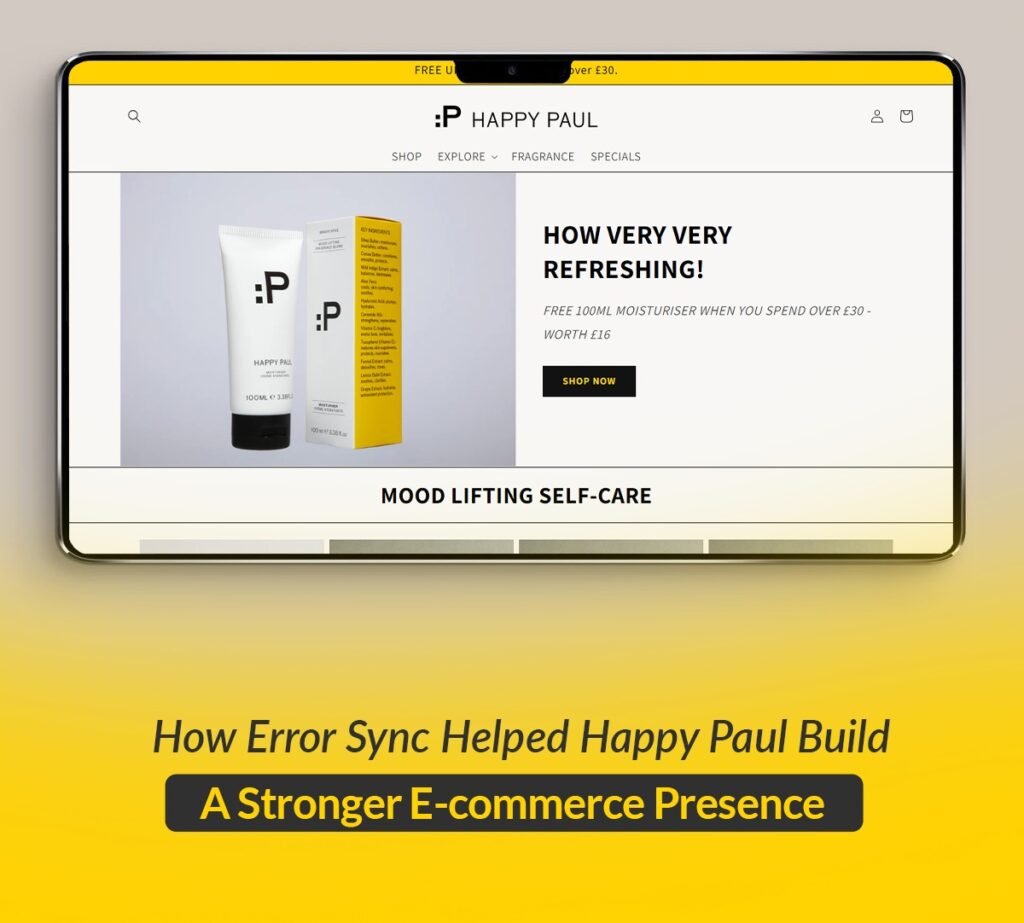
Happy Paul is a UK-based self-care brand built on a simple but powerful idea: everyday products that lift your mood and make routine moments feel a little better. From fragrances and body washes to face cleansers, candles, and thoughtful gifts, everything is designed with one goal in mind: to support wellbeing and, in their own words, “make you smile.”
The concept was there. The emotion behind the brand was genuine. But the website wasn’t fully translating that feeling to the customer experience. And that’s where many promising brands quietly lose momentum, because what they stand for doesn’t quite come through when it matters most.
The Numbers:
- Started at: 12–15 orders/day (Facebook DMs only)
- After social campaigns: 25–30 orders/day
- With Shopify store: 40–45 orders/day (regular months)
- Peak season: 70–90 orders/day
Project Details
The Real Challenge
Happy Paul was not a generic skincare label trying to compete on price. It had something more specific: a story about joyful self-care, responsible ingredients, and a positive brand experience. The site references a founder story, a "Happy Guarantee," mental health support through YoungMinds, and a Made in UK identity. That kind of brand asks more of a website than a basic product listing does. A visitor landing on a lifestyle brand like this is not just looking for specs and a checkout button. They are quietly asking, "What is this brand about?" Can I trust it? Is it made for someone like me? If the site cannot answer those questions quickly and confidently, they leave. The issue was not the products. It was the gap between what the brand stood for and what the website was actually communicating.
What Error Sync Set Out to Fix
When Happy Paul brought us in, the goal was straightforward: close that gap. The project touched a few interconnected things, all of which matter more than they might look like individually.
Brand presentation came first
Happy Paul sells a feeling as much as a product. Joy, well-being, uplifting fragrance. That positioning has to be immediately obvious to someone who has never heard of the brand before. If visitors have to work to understand what makes the brand different, most will not bother. The web development work focused on bringing that clarity through from the first page.
Product discovery needed to feel natural
The store spans multiple categories: fragrance, body wash, cleansers, sale collections, gift picks. With artisan fragrance products priced up to £45, this is not an impulse-buy store. Customers browse. They compare. They want to move between collections without running into dead ends or confusing layouts. Small friction points in navigation are easy to overlook during a build, but they quietly damage conversion rates.
Trust signals needed better visibility
Happy Paul already had the right reassurances: Free Delivery, Secure Payment, Made in UK, Happy Guarantee. Those things genuinely move first-time buyers. The problem is that trust signals only work if people actually see them, and see them at the right moments in the shopping journey. Better placement and visibility made those elements do the job they were supposed to do.
Content and commerce had to connect
Happy Paul is not a purely transactional site. There is a journal, an ingredients glossary, an Our Story page, a full Happy Guarantee section. That is a smart content strategy, but it only pays off if the paths between those pages and the product collections feel intentional. A visitor reading about ingredients should be one easy step away from the relevant product. That kind of architecture does not happen by accident.
The foundation needed to be built for growth
A website that works today but becomes difficult to manage as the range expands is not really a solution. Part of the work was building something that makes future campaigns, new collections, and merchandising updates easier to execute without starting over.
What Changed
The honest answer is that no public before-and-after analytics are available, so there are no percentage lifts to quote here. What changed was structural and strategic.
The store became better at doing its actual job: helping someone who lands on the site understand the brand, feel comfortable enough to browse, and find a clear path to purchase. For a lifestyle brand at this stage of growth, that is what good web development looks like in practice. The site footer now carries “Powered by Error Sync,” which reflects our ongoing role in the build.
Why This Matters Beyond Happy Paul
A lot of lifestyle and self-care brands hit the same wall. Strong concept, good products, real differentiation, but a website experience that does not fully support any of it.
The mistake is treating web development as a visual task. It is not. It is a conversion task, a trust task, and a communication task, all at once. The design is just the surface. Underneath, the structure, flow, and content architecture determine whether the site actually helps the business grow.
For fragrance, grooming, and self-care brands especially, the emotional side of the experience matters enormously. People are not just buying a body wash. They are buying into a feeling. If the website does not create that feeling, the product alone rarely closes the gap.
What We Do at Error Sync
We don’t design websites to simply look good, we build them around how a business actually sells. For Happy Paul, that meant creating a digital storefront that truly reflected its product range, told its brand story clearly, and guided customers through a journey that naturally leads to a purchase.
The brand already had the hard parts figured out: a clear concept, a genuine emotional connection, and products people would love. What it was missing was a website strong enough to carry that promise all the way through.
That’s exactly what we built, a site that doesn’t just represent the brand, but actively works to convert.